Rising costs and dropping lead quality on Meta? You’re not the only one dealing with it.
Running Meta Ads in 2026 feels like a different game entirely. A familiar pattern plays out for a lot of businesses: campaigns start strong, CPC creeps up, lead quality slips, and scaling gets harder from there. The issue usually isn’t the product. It’s holding onto optimisation habits from before the Andromeda update.
Meta’s AI now leans heavily on behavioural prediction, creative relevance, and engagement quality. If lower costs and better leads are the goal, the fix isn’t tweaking more settings, it’s understanding how Meta’s AI actually learns from your creatives.
Strategy 1: Simplify Your Campaign Structures
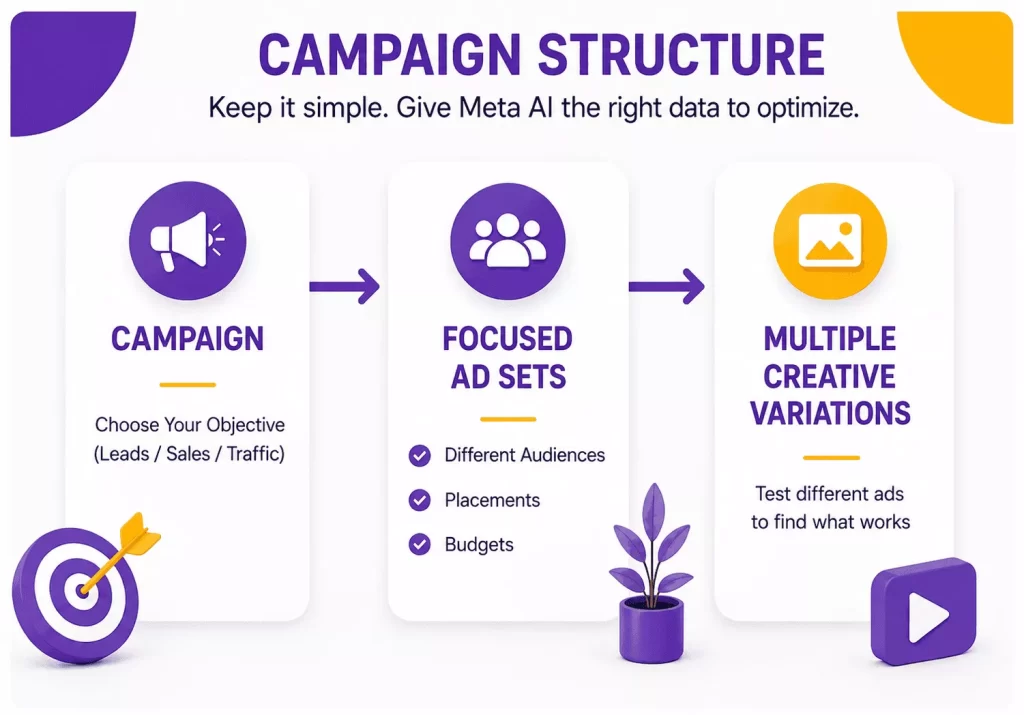
A lot of advertisers end up with overlapping audiences, too many ad sets, and fragmented structures without realising it. This creates what’s effectively “learning instability” for Meta’s algorithm. The AI can’t clearly tell which audience-creative combination is actually driving results, and budget gets wasted while performance stays inconsistent.
Simpler structures give Meta bigger data pools, cleaner optimisation signals, and more stable learning. Rather than duplicating audiences to test different interests, put that energy into creative testing and conversion quality instead.
How to simplify:
- A useful rule of thumb: 1 campaign, 2-3 ad sets, with multiple creatives inside each.
- Consolidate your audiences: Instead of running 10 separate interest-based ad sets, combine them into one or two broader ones.
- Let the AI do its job: Simplifying gives Meta’s AI more data per ad set, which helps it exit the learning phase faster and deliver more effectively.
Strategy 2: Use Advantage+ Campaigns With Intent
Meta Advantage+ Campaigns automate targeting, placements, delivery, and budget allocation. They’re genuinely useful for scaling campaigns and lead generation.
That said, automation can’t fix weak fundamentals. It’s not a magic fix. If the creative is weak, the offer isn’t compelling, or the site loads slowly, Advantage+ will just automate that failure more efficiently.
When Advantage+ makes sense:
- For scaling: Once there’s a proven creative and offer, Advantage+ can help find new audiences at scale.
- For lead gen: It works particularly well for lead generation since it optimises specifically for the likelihood of someone completing a form.
The rule that matters most: get the creative, offer, and landing page fully dialed in before switching Advantage+ on. The AI needs something solid to build from.
Strategy 3: Put More Weight on Creative Testing
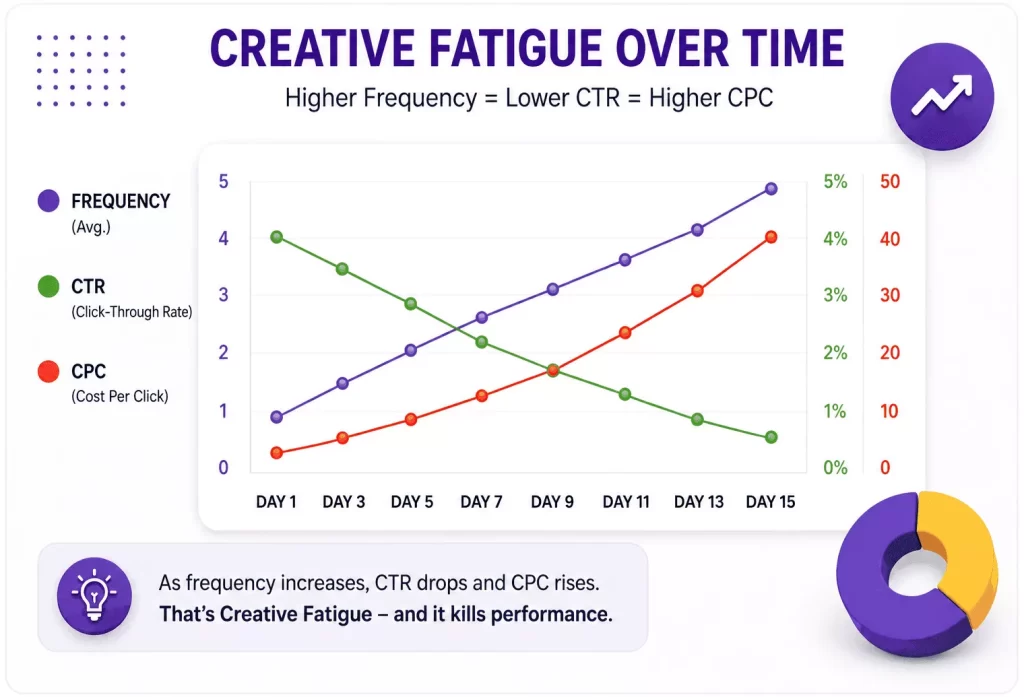
Creative variety is one of the biggest levers for performance. A lot of advertisers keep adjusting targeting while ignoring creative fatigue entirely, which is a costly mistake.
Rather than rebuilding campaigns from the ground up, focus on testing individual creative elements: hooks, thumbnails, CTAs, video styles, and storytelling angles.
A simple creative testing framework:
| Test Element | Variations |
| Hook | 3 |
| CTA | 2 |
| Video Style | 2 |
| Creative Angle | 3 |
If CTR is dropping, CPC is climbing, and frequency is rising at the same time, that’s usually creative fatigue, not a targeting problem. Refresh creatives every 10-14 days to keep ads feeling current.
Strategy 4: Build for Mobile-First Users
Most Meta traffic comes through mobile devices, and that single fact should shape how creatives, landing pages, checkouts, and lead forms all get designed.
Ignoring the mobile experience is one of the quickest ways to tank a campaign’s performance.
Mobile optimisation checklist:
- Vertical creatives (9:16): Use formats built for the mobile feed
- Fast-loading pages: Page speed matters a lot here; run pages through Google PageSpeed Insights
- Clear, thumb-friendly CTA buttons: Make sure buttons are large enough and easy to tap
- Short paragraphs: Break text into chunks that scan easily
- Mobile-friendly forms: Keep the number of fields to a minimum
- Simplified checkout flows: Strip out any unnecessary steps that add friction
Even small friction points, a slow-loading image or a button that’s too small to tap accurately, can meaningfully drag down conversion rate.
Strategy 5: Fix CTR Before You Scale
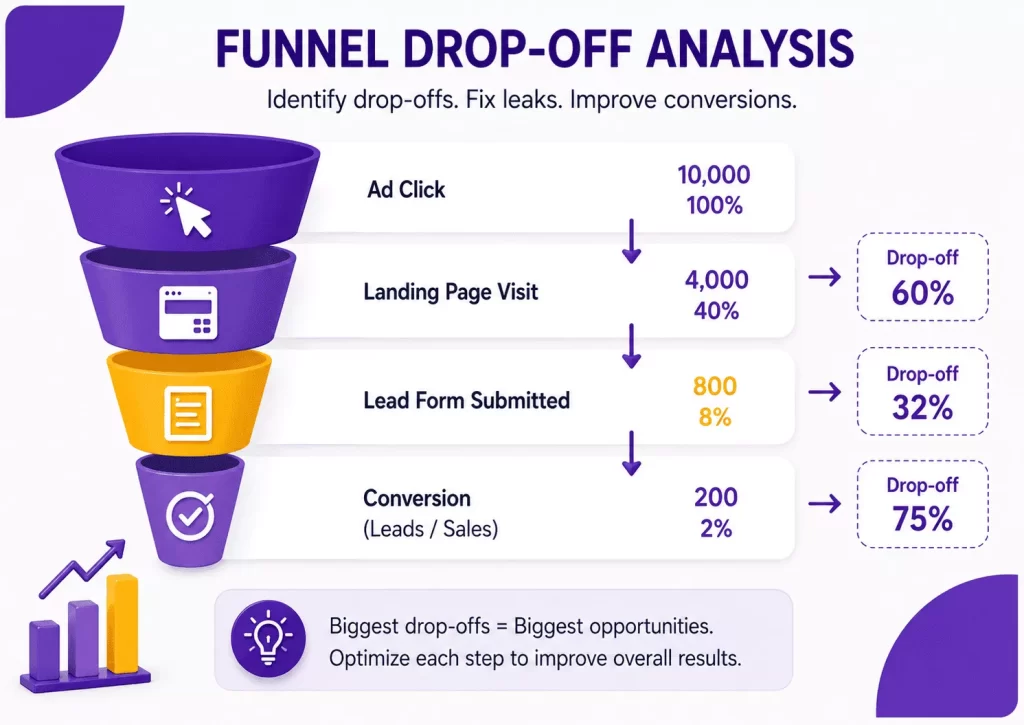
Scaling a weak campaign is a bit like pouring fuel on a small fire, it spirals fast and burns through budget. Before increasing spend, look closely at click-through rate first.
A strong CTR points to better audience resonance, stronger messaging, and more relevant creative. A low CTR means the ad simply isn’t connecting with the people seeing it, and scaling will just amplify the losses rather than the wins.
What to actually do: if CTR is low (under 1-2% for lead gen), don’t scale the budget yet. Pause the campaign or ad set and fix the creative or offer first.
Strategy 6: Make Retargeting Feel Less Aggressive
Showing the same ad to the same person 20 times a day builds fatigue and ad blindness fast. Instead of bombarding the audience, build a natural, sequential journey that unfolds over time.
A sequence feels more human, builds trust gradually, and tends to produce higher-quality conversions.
Example retargeting flow:
| Timeline | Goal |
| 0-7 Days | Service or product reminder |
| 7-14 Days | Testimonials and trust-building |
| 14-30 Days | Offer or urgency |
This kind of sequencing respects the person’s experience and moves them through a decision-making funnel instead of just wearing them down.
Strategy 7: Improve Conversion Rates Through CRO
Sometimes the real issue isn’t Meta Ads at all, it’s conversion friction on the website. Weak landing pages, confusing forms, and slow load times hurt performance more than most targeting problems do.
Common CRO issues include weak trust signals, unclear product explanations, confusing forms, and clunky checkout flows.
How to diagnose and fix it:
- Use tools like Hotjar or Microsoft Clarity to study user behaviour
- Check heatmaps to see where people are clicking and scrolling
- Review session recordings to spot where users get stuck or drop off
- Run A/B tests on landing pages to find what actually performs best
Fixing these hidden conversion issues can dramatically lift the ROI on every dollar spent on ads.
Comparing Strategies by Cost and Timeframe
| Strategy | What It Costs You | Realistic Timeframe |
| Simpler Campaigns | Just a few minutes in Ads Manager | 1-2 days (helps AI exit the learning phase faster) |
| Advantage+ Campaigns | Nothing, it’s a free Meta tool | 1-2 days |
| Creative Testing | Low, mainly design time | 1-3 weeks |
| Mobile-First Optimisation | Low, design tweaks | 1-2 days |
| CTR Analysis and Scaling | Nothing, just analysis | 1-2 days |
| Natural Retargeting | Low, time to set up sequences | 1-2 weeks |
Geofencing: A Practical Fix for Local Businesses
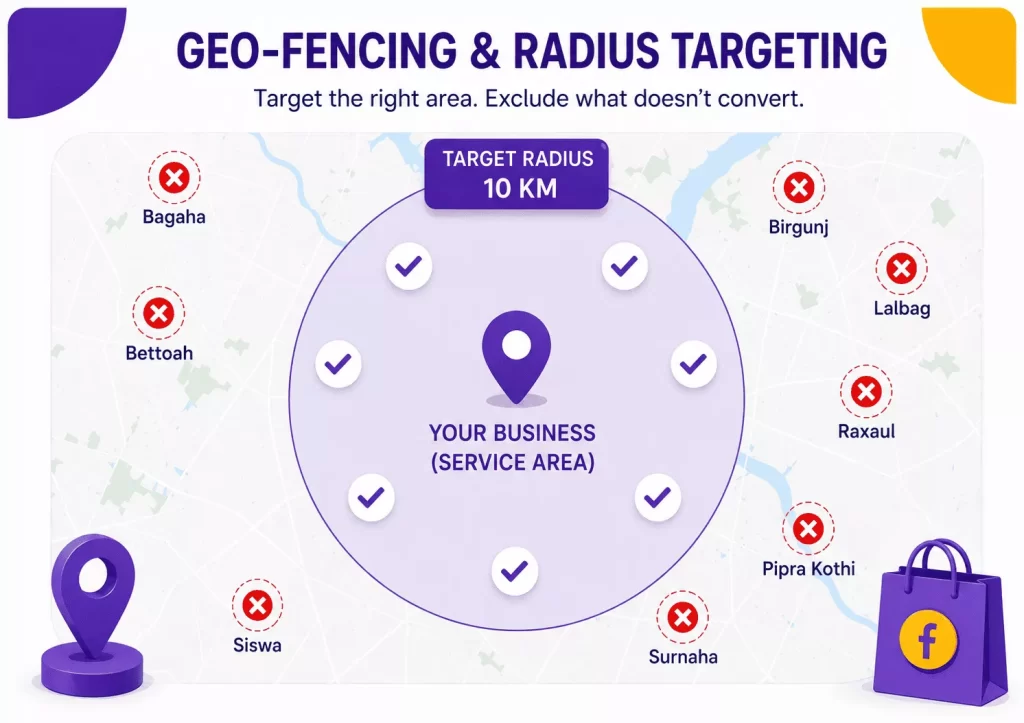
A lot of local businesses end up with irrelevant leads from outside their service area, which wastes both ad budget and the sales team’s time.
What geofencing does: it lets you draw a virtual boundary around a specific geographic area and show ads only to people within that radius.
Why it’s worth it: CPC might tick up slightly, but lead quality improves dramatically because the audience is genuinely reachable. For local businesses, relevant leads matter far more than cheap ones.
Tracking checklist worth running through:
- Confirm Meta Pixel events are firing correctly
- Make sure Conversion API (CAPI) is set up to send server-side data
- Track phone calls accurately as conversions
- Use Meta Events Manager to test and confirm your setup is accurate
Meta Ads Optimisation Checklist for 2026
Campaign Setup
- Pixel installed and verified
- Conversion API configured
- Simplified campaign structure (1 campaign, 2-3 ad sets)
- Mobile-first landing pages ready
- Creative testing process active
Creative Optimisation
- Multiple hooks tested
- User-generated content (UGC) creatives added
- Reels content included in the mix
- Creative fatigue monitored (refresh every 10-14 days)
Conversion Optimisation
- Fast-loading pages (80+ on PageSpeed)
- CTA placement clear and prominent
- Heatmaps reviewed (Hotjar/Clarity)
- Forms kept short and simple
- Trust signals present (testimonials, badges)
Conclusion
Meta Ads optimisation in 2026 isn’t about chasing hidden tricks or constantly fiddling with settings anymore. The platform now runs on engagement quality, creative relevance, and behavioural prediction.
The advertisers seeing steady growth right now are the ones consistently testing creatives, refining the customer journey, improving lead quality, and adapting to how Meta’s AI actually works. That approach matters far more than any so-called secret hack.
Pick one strategy from this guide and start there, it’s a solid first step toward lower costs and better lead quality.
Frequently Asked Questions
What changed after Meta’s Andromeda update? The Andromeda update reshaped Meta’s AI-driven ad delivery system. Campaign optimisation now depends much more heavily on creative relevance, engagement quality, and behavioural prediction rather than granular manual targeting. Creative has become the primary targeting signal.
Is broad targeting better in 2026? In a lot of cases, yes. Broad targeting paired with strong creative often outperforms tightly restricted audiences, since it gives the AI more data to find the best-performing segments. That said, local businesses still benefit from geofencing and geographic refinement.
Why are my Meta Ads bringing in irrelevant leads? This usually comes down to overly broad targeting (especially without geofencing), weak geographic filtering, low audience relevance, or inaccurate conversion signals. Use geofencing to limit location, and double-check that Pixel and CAPI tracking are set up correctly.
How often should creatives be refreshed? Most advertisers refresh creatives every 1-3 weeks depending on audience size, spend, ad frequency, and how quickly engagement drops off. Keep an eye on the frequency metric as a key signal.
What matters more now, targeting or creative? Both still matter, but since the Andromeda update, creative quality and engagement signals carry much more weight than they used to. Strong creative can compensate for imperfect targeting, but great targeting can’t rescue a weak creative.