What is Zero-Party Data?
If you’ve been wondering what is zero-party data and why it’s suddenly everywhere -you’re asking the right question at the right time.
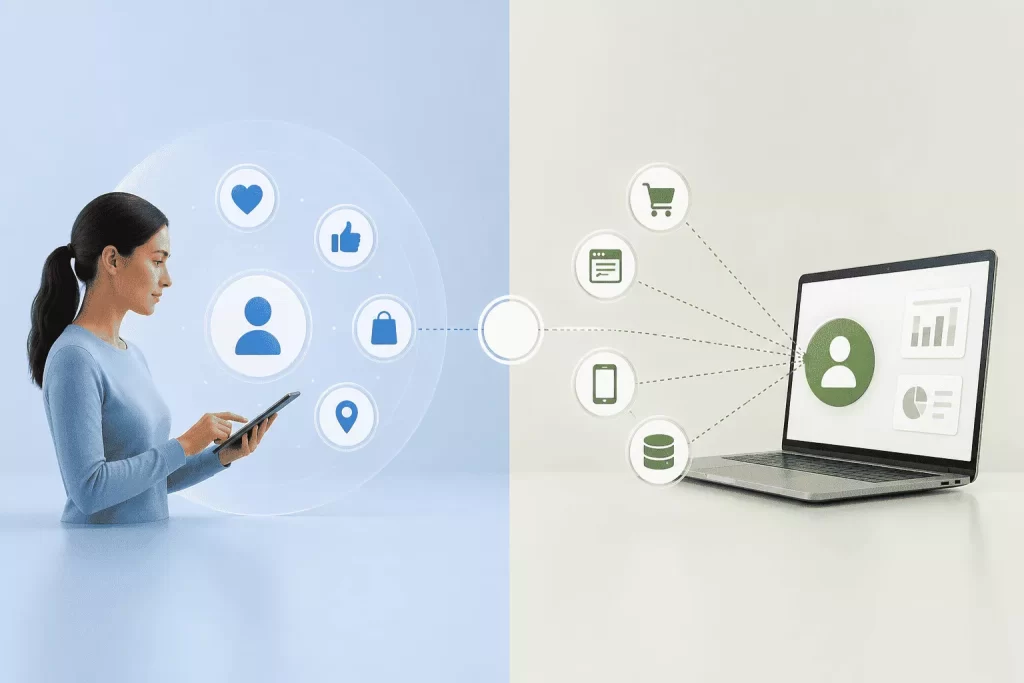
Zero-party data is information a customer intentionally and proactively shares with a brand. No hidden tracking. No guessing. The customer tells you directly what they want, what they like, and how they prefer to be contacted -in exchange for something valuable in return.
The term was coined by Forrester Research, and the “zero” is deliberate: this data comes before any passive observation. It’s the most honest form of customer insight available.
Common examples include:
- Product preferences shared via a quiz (“What’s your skin type?”)
- Communication preferences -email vs. SMS, daily vs. weekly
- Purchase intent signals (“I’m planning to buy in the next 30 days”)
- Lifestyle information entered in a profile builder
- Declared interests selected in a preference centre
- Feedback submitted via polls or post-purchase surveys
This is fundamentally different from data you collect about someone. This is data they give you -and that distinction changes everything about how you can use it, and how customers perceive you for asking.
Zero-Party Data vs First-Party Data: The Difference That Matters
The most searched question in this space is zero-party data vs first-party data -and it’s worth clearing up properly, because most brands confuse the two, and the confusion leads to poor strategy.
| Data Type | Source | Example | Consent Level |
| Zero-Party | Customer tells you directly | Quiz responses, preference forms | Explicit -they chose to share |
| First-Party | Observed from your own platforms | Website clicks, purchase history | Implied -you tracked behaviour |
| Second-Party | Shared by a trusted partner | Co-branded campaign data | Varies by arrangement |
| Third-Party | Purchased from data brokers | Audience segments, data lists | Minimal or none |
Here’s the key distinction worth remembering:
First-party data is what your customer does -page views, clicks, purchases, time on site. You collect it passively through your own platforms.
Zero-party data is what your customer says -their preferences, intentions, and interests, shared directly and deliberately.
Both are valuable. The smartest zero-party data strategy in 2026 combines both: use what customers tell you to anchor personalisation, and what they do to validate and refine it. Think of them as complementary signals, not alternatives.
Why Zero-Party Data Collection is the Most Important Marketing Skill of 2026
The Cookie Story: What’s Actually Happening in 2026
This is where a lot of blogs get it wrong, so let’s be precise.
Google did not fully deprecate third-party cookies in Chrome. After years of delays, Google scrapped its Privacy Sandbox cookie replacement plan -and in October 2025, retired most Privacy Sandbox APIs due to low adoption and regulatory pressure from the UK’s Competition and Markets Authority.
However -and this is the part that matters for your business -the third-party cookie landscape is already severely degraded:
- Apple Safari has blocked third-party cookies by default since 2020 via Intelligent Tracking Prevention (ITP)
- Mozilla Firefox has blocked them since 2019 via Enhanced Tracking Protection (ETP)
- Brave, DuckDuckGo and other privacy browsers block them by default
- Ad blockers affect a significant portion of desktop traffic globally
The practical result: a substantial share of your audience -depending on your industry and platform, potentially 30–50% -is already invisible to third-party cookie tracking, regardless of Chrome’s position. The “cookieless world” didn’t arrive as a single announcement. It arrived quietly, browser by browser, user by user.
This is precisely why zero-party data collection matters right now. It works regardless of browser restrictions, cookie status, or platform tracking changes. It’s yours, and nothing can take it away. (Google Privacy Sandbox |OneTrust, April 2025)
Adtorise note: If you’re running paid media campaigns on Google or Meta, this directly affects your audience targeting and retargeting effectiveness. See how we help eCommerce brands build resilient ad strategies →
Australia’s Privacy Act: What’s Actually Changed in 2026
The Privacy and Other Legislation Amendment Act 2024 (POLA Act) received Royal Assent on 10 December 2024 -marking the most significant reform to Australia’s privacy framework since 1988. Here’s the current 2026 reality:
- Already in effect: Enhanced OAIC regulator powers, new civil penalties (up to AUD $3.3M for companies), stronger cybersecurity requirements under APP 11
- In effect from June 2025: Statutory tort for serious invasions of privacy -meaning individuals can now sue brands for serious privacy breaches without relying solely on the OAIC
- From July 2026: An estimated 100,000+ small businesses will become regulated by the Privacy Act for the first time, as the $3M annual turnover exemption is being removed
- From December 2026: Automated decision-making transparency obligations take effect -brands must disclose in their privacy policies when and how AI is used in decisions that affect individuals
A second tranche of reforms is actively being progressed, with the Attorney General confirming in February 2026 that the government is “progressing a second tranche of privacy reforms to ensure the Privacy Act is fit for purpose in the digital age.” (OAIC |Lander & Rogers, February 2026)
Zero-party data -built on explicit consent and transparent exchange -is designed for this exact regulatory environment.
The Personalisation Gap Is Costing Real Revenue
According to Braze’s 2025 Global Customer Engagement Review, 99% of marketing executives report that data privacy concerns have impacted their personalisation plans. Meanwhile, industry research consistently shows a significant gap: brands believe they understand customers far better than customers actually feel understood.
That gap shows up in irrelevant emails, poor product recommendations, low repeat purchase rates, and wasted ad spend. Zero-party data closes it -because there’s no inference or approximation involved. The customer told you directly.
7 Best Zero-Party Data Collection Methods That Actually Work
1. Interactive Quizzes and Product Finders
This is the highest-converting zero-party data collection format available. A skincare quiz, a fitness goal selector, a gift recommendation tool -these feel like experiences, not forms. Customers get a useful output; you get accurate preference data.
Verified case study: e.l.f. Cosmetics ran a product-matching survey and achieved an 84% completion rate, with over 11 data attributes captured per customer.
2. Preference Centres
Give customers a self-service dashboard to control what they receive -email frequency, product categories, contact channels, content types. Done well, a preference centre becomes a personalisation engine that customers run themselves -and feel good about.
The gold standard: show customers exactly what data you hold, explain how it’s used, and make it easy to update or delete preferences at any time.
3. Progressive Profiling
Instead of a 10-question form on first visit, collect one or two data points at each natural touchpoint -sign-up, post-purchase, loyalty programme milestone, re-engagement. Over time you build a rich profile without ever feeling intrusive. Each question earns its place by being relevant to that specific moment.
4. Post-Purchase Surveys
The moment after a purchase is peak engagement. A two-question survey -“What made you choose us?” or “What are you shopping for next?” -captures intent data while the customer relationship is at its warmest. Keep it short. Two questions max.
5. Email Self-Segmentation Flows
Send subscribers an email asking them to “tell us about yourself” in exchange for a more personalised experience. Let them self-select into categories -new parent, gift shopper, loyal customer, professional buyer -and tailor everything from subject lines to product recommendations accordingly.
Verified case study: My Jewellery used preference-based email segmentation and increased email open rates by 20%.
6. Contests and Giveaways With Entry Questions
Run a competition where entry requires answering a few quick preference or interest questions. Participants are motivated to share genuine information, and you collect accurate data tied to real intent -not guessed demographics.
7. On-Site Polls and Intent Prompts
A single-question pop-up -“What brought you here today?” or “Shopping for yourself or someone else?” -captures intent at the moment it matters, with almost no friction. This works especially well for returning visitors.
Building Your Zero-Party Data Strategy: A Step-by-Step Guide
A solid zero-party data strategy isn’t just about collection. It’s about building a system that continuously improves your customer relationships -and directly feeds your paid and owned media performance.
Step 1: Start With a Business Goal, Not a Data Question
Ask yourself: “What decision will this data help me make better?”
Better email relevance? Smarter Google Ads audience segmentation? Higher product page conversion? Fewer wasted retargeting impressions? Your collection design flows from the answer -not the other way around.
Step 2: Design a Value Exchange Worth Saying Yes To
Nobody shares personal information for nothing. Your offer needs to feel genuinely worthwhile:
- Immediate value: Discount, free shipping, exclusive access
- Experience value: Personalised recommendations, tailored quiz results
- Relational value: Feeling understood as an individual, not a data point
The stronger your exchange, the more -and more accurate -data you’ll receive.
Step 3: Map Collection to Your Customer Journey
Place zero-party data collection at your highest-engagement moments:
- Acquisition: Welcome quiz, sign-up preference selector
- Activation: Onboarding survey, style profile builder
- Retention: Loyalty programme preferences, anniversary check-in
- Re-engagement: “Tell us what you need” win-back campaign
Each stage offers a natural, non-intrusive opportunity to learn more.
Step 4: Integrate Into Your Marketing Stack
Zero-party data sitting in a spreadsheet does nothing. Connect it directly to:
- CRM (HubSpot, Salesforce, Klaviyo) for segmentation and automation triggers
- Customer Data Platform (CDP) for unified, cross-channel customer profiles
- Meta Ads and Google Ads for improved custom audience targeting and exclusions
Adtorise note: Zero-party data dramatically improves Meta and Google Ads performance when used to build sharper Custom Audiences and lookalikes. See our D2C eCommerce PPC services → or read our guide to Google Ads KPIs →
Step 5: Activate With Privacy-First Marketing Personalisation
This is where privacy-first marketing delivers real ROI:
- Email: Dynamic content blocks, personalised product feeds, tailored subject lines
- On-site: Show returning customers the product categories they’ve declared interest in
- Paid media: Use declared purchase intent to sharpen retargeting -and exclude customers who’ve already stated they’re not in-market
- Loyalty programmes: Offer rewards aligned to what members actually want, not generic points
- Product development: Aggregate preference data reveals real market gaps before they show up in sales reports
Step 6: Stay Transparent -Always
Customers who share data want to know it’s being used responsibly. Under Australia’s POLA Act 2024, you must have a clearly expressed, up-to-date privacy policy -and from December 2026, disclose automated decision-making in that policy.
Make it easy for customers to see what you hold, update their preferences, and opt out. This isn’t just compliance -it’s the foundation of trust that makes zero-party data sustainable long-term.
Step 7: Measure What Matters
- Data yield rate: What % of touchpoint visitors complete your quiz or survey?
- Personalisation lift: How much better does ZPD-personalised content perform vs generic?
- Profile richness: Average number of declared attributes per customer profile
- LTV correlation: Do customers with richer zero-party profiles have higher lifetime value?
Run A/B tests on incentives, question formats, and placement timing to continuously improve.
Zero-Party Data + AI = The Future of Personalisation
The brands pulling ahead in 2026 are combining zero-party data strategy with AI-powered personalisation to deliver experiences that feel genuinely tailored.
The old model: collect behavioural data → feed into ML model → predict what customers might want.
The new model: customers tell you what they want → AI uses that as an anchor signal → behavioural data validates and refines in real time.
The result is personalisation that’s faster, more accurate, and more trusted -because it starts from truth, not inference. And crucially, from December 2026, if your brand uses AI to make decisions that affect individuals, you’ll need to disclose this in your privacy policy under the new APP 1.7 requirements. Zero-party data gives you the consent-driven foundation to use AI responsibly and compliantly.
The Australian Opportunity: Why Local Brands Should Move Now
Australia’s Privacy Act reforms are creating a compliance forcing function -but they’re also creating a market opportunity. Brands that proactively offer transparent, consent-driven data exchanges will stand out in a market where most competitors are still scrambling to update their privacy policies.
From 1 July 2026, an estimated 100,000+ small businesses will be regulated by the Privacy Act for the first time. For those businesses, building zero-party data habits now -before enforcement begins -is far easier than retrofitting a data strategy under regulatory pressure.
For Australian D2C eCommerce brands, retailers, and service businesses, this is a genuine competitive moat. Build the capability now.
Common Mistakes That Destroy Zero-Party Data Strategies

Asking too much too soon. A 15-question form on first visit will be abandoned. Start with 2–3 high-value questions and build progressively.
Collecting data and not using it. If a customer declares they prefer SMS and you keep emailing them, you’ve destroyed the trust that the exchange was meant to build.
Weak value exchange. “Fill out this form” gets ignored. “Tell us your style and we’ll personalise your entire experience” gets filled out enthusiastically.
Treating it as a one-time project. Customer preferences change. Build update prompts into your customer lifecycle so profiles stay fresh. Stale zero-party data is worse than no data.
Ignoring the compliance layer. Even voluntarily shared data must be collected, stored, and used in line with Australia’s Privacy Act. With the OAIC actively conducting compliance sweeps in 2026, this is not the year to assume good intentions are enough.
Real-World Results
ASICS used an interactive experience to collect an average of 21.5 data points per user, feeding richer personalisation across their entire digital funnel.
The NBA launched a season-opener fan prediction quiz that captured leads and declared preferences at scale, while giving fans a genuinely engaging experience.
baby-walz (baby products retailer) asks new subscribers basic questions about their child at registration. The result: dramatically more relevant communications and measurably higher email engagement.
The consistent pattern across all of these: the best zero-party data collection experiences feel like a service, not a survey.
Your 30-Day Action Plan
Week 1 -Audit: What are you currently tracking? Where are the data gaps? What decisions are you making without proper customer insight? Map the moments where customers are most engaged with your brand.
Week 2 -Identify Opportunities: Pick your top 2 collection opportunities -highest-traffic, highest-engagement touchpoints. Welcome flow and post-purchase are consistently the fastest wins.
Week 3 -Build: Design one quiz, preference form, or survey. Keep it to 3–5 questions. Define the value exchange clearly. Build it into your existing platform.
Week 4 -Launch and Optimise: Track completion rates. Connect data to your CRM. Run one personalised campaign segment based on what you’ve collected. Measure the lift.
You don’t need a massive technology investment to start. You need a clear goal, a compelling offer, and a commitment to actually using what customers tell you.
Conclution
The era of surveillance marketing is ending -not because of a single regulatory announcement or a browser update, but because customers are demanding something different. They want to be understood, not tracked. They want personalisation that feels like service, not surveillance.
A strong zero-party data strategy isn’t just a privacy-compliant alternative to third-party data. It’s a fundamentally better way to understand your audience, build genuine relationships, and deliver the kind of personalised experiences that create real loyalty.
In 2026, privacy-first marketing isn’t a constraint. It’s your competitive advantage -especially in Australia, where regulatory pressure and customer privacy expectations are both accelerating.
The brands that start now will have a head start that compounds with every customer interaction.
Ready to build a zero-party data strategy that improves your paid media performance and customer relationships? Talk to the Adtorise team →
Want to understand how data strategy connects to your Google and Meta Ads performance? Explore our eCommerce PPC services →orread more on our blog →
FAQ: Zero-Party Data Strategy
No. First-party data is behavioural -it’s what you observe when customers interact with your website, app, or emails (clicks, purchases, page views). Zero-party data is declarative -it’s information customers actively choose to share, such as preferences, interests, or purchase intent. Both are valuable, and the strongest strategies combine them.
Yes -in fact, zero-party data is better positioned for compliance than any other data type. Because customers actively share it with full awareness, it satisfies the consent requirements under Australia’s Privacy Principles. However, you still need a compliant privacy policy, must only use the data for the stated purpose, and must allow customers to update or delete their information. Under the POLA Act 2024, these requirements are actively enforced. (OAIC Privacy Act guidance)
Start simple: add 2–3 preference questions to your email sign-up form, or create a short product quiz that delivers a personalised recommendation. These require minimal technical investment and can deliver immediate results in email relevance and conversion. From there, layer in progressive profiling and preference centres as your data capability matures.
Declared preferences and purchase intent from zero-party data can be used to build sharper Custom Audiences in Meta Ads and Customer Match audiences in Google Ads. You can target people who’ve stated they’re in-market, exclude those who’ve said they’re not, and build lookalike audiences from your highest-intent segments. This directly reduces wasted ad spend and improves ROAS. See how Adtorise builds data-driven paid media strategies →
No. The value of zero-party data isn’t about cookies -it’s about accuracy, consent, and trust. Even in scenarios where third-party tracking is technically available, declared customer data outperforms inferred data in personalisation accuracy. And as Australian privacy regulations tighten through 2026 and beyond, consent-driven data strategies will only become more important, not less.
Research consistently shows that completion rates drop significantly beyond 5 questions for first-time interactions. Start with 2–3 high-value questions and use progressive profiling to collect additional data over subsequent touchpoints. Quality of data matters more than quantity of questions.
A quiz is typically a one-time collection experience -engaging, fun, delivers a result. A preference centre is an ongoing, editable profile where customers can control their data over time. Both are valuable and complementary: use quizzes for acquisition and engagement, preference centres for retention and profile maintenance.