Most local Australian businesses set up Google Ads, point it at an entire state, and wonder why their budget disappears with nothing to show. The problem is not Google Ads. It is geography.
City-level targeting is the single most impactful change a local business can make to its Google Ads strategy. In campaigns we manage, suburb-targeted ads consistently reduce CPC compared to state-wide targeting – because the budget concentrates on people who can actually become customers, in the right area, searching right now.
This guide covers exactly how to set up Google Ads geo targeting in Australia – from Sydney suburbs to Brisbane postcodes to regional towns – so your ads work harder and your cost per lead drops.
What City-Level Targeting Does for a Local Business

City-level targeting restricts your Google Ads to a defined geographic area – a city, suburb, radius, or postcode. Anyone outside that boundary does not see your ad, which means you stop paying for clicks from people you can never serve.
For Australian local businesses, this matters more than in many other markets. Australia’s population is concentrated in a handful of major metros – Sydney, Melbourne, Brisbane, Perth, Adelaide – but within each city, suburbs vary enormously in demand, competition, and customer value.
Grove Foundry’s 2025 Australian Google Ads research confirms that the average CPC across Google Search in Australia is $2 to $4 AUD, but that same keyword in Sydney CBD can cost three to four times more than in a regional area. Precise geographic targeting is how you control that cost.
Tight city targeting + locally relevant ad copy + city-specific landing pages = stronger Quality Score, lower CPC, and more phone calls.
The Four Location Targeting Options in Google Ads
City Targeting
Target an entire city – Sydney, Melbourne, Brisbane, Perth, or any regional centre. Every user within the city boundaries is eligible to see your ad. This works well for businesses that serve an entire metro area.
Suburb Targeting
Suburb targeting in Google Ads is one of the most underused tools available to Australian local businesses. A plumber in Paddington does not need to show ads in Parramatta. A dentist in Fitzroy does not need to spend budget in Frankston.
Local Marketing Group’s setup guide recommends targeting specific suburbs like “Paddington, QLD” or radius targeting like “20km around Milton” rather than selecting all of Brisbane – a mistake that wastes budget on customers who will never convert.
Radius Targeting
Set a distance around your business address or service centre. A mechanic might target 10km. A mobile cleaner might target 25km. You can layer multiple radii – 5km, 10km, 20km – and apply different bid adjustments to each. Higher bids for nearby customers who are most likely to convert, lower bids for the outer ring.
Postcode Targeting
When data shows certain postcodes outperform others, break them out separately. Assign higher budgets to high-converting postcodes. Exclude postcodes that generate clicks but never produce leads.
The Google Ads Setting That Wastes the Most Local Budget
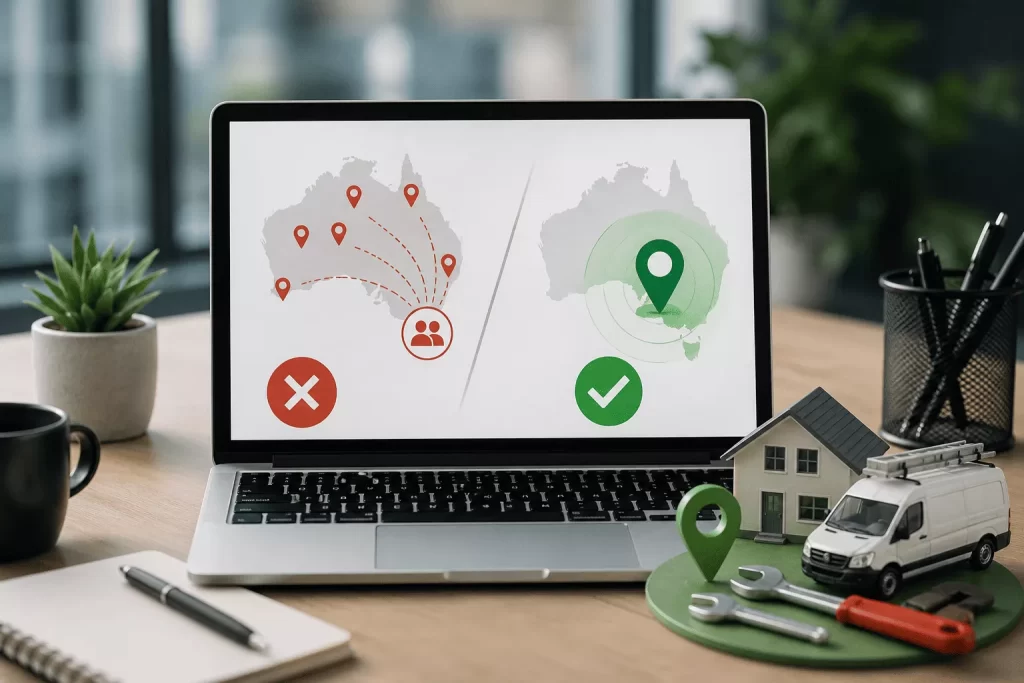
One setting error costs Australian local businesses significant wasted budget every year.
Google Ads has two location targeting options:
Presence – shows ads to people who are physically in your targeted area. This is what local service businesses need.
Presence or Interest – shows ads to people in your area AND people who have shown interest in it. Someone in Melbourne researching “plumbers in Brisbane” sees your Brisbane plumbing ad, clicks it, and wastes your budget.
Google’s official Help Centre confirms that “Presence” targeting is the right choice when your service is strictly limited to people physically present in a location – in-store service, local delivery, any trade or professional service.
The problem: Google defaults to “Presence or Interest.” You have to manually change it. If you set up a campaign and never touched this setting, you are likely paying for irrelevant traffic right now.
How to fix it: Go to Campaign Settings → Locations → Location Options → change to “People in or regularly in your targeted locations.”
How to Build a City-Level Google Ads Strategy in Australia
Step 1: One Campaign Per City or Service Zone
If your business operates in multiple suburbs or cities, build separate campaigns – not ad groups. One campaign for North Shore Sydney. One for Inner West. One for Eastern Suburbs.
Each campaign gets its own budget, its own bid strategy, and its own performance data. You see exactly which areas are generating leads and at what cost – then you shift budget to what works.
Step 2: Use Location-Specific Keywords
Generic keywords are expensive and unqualified. Adding a suburb or city name increases relevance, often lowers CPC, and attracts searches with genuine local intent.
Examples that work in Australia:
- “emergency plumber Inner West Sydney”
- “dentist near me Fitzroy”
- “AC repair Southbank Brisbane”
- “wedding photographer Fremantle”
“Near me” keywords are worth including separately. Google connects them to local intent automatically, and they convert well because the searcher is ready to act.
Step 3: Write Ad Copy That Names the Location
An ad headline that reads “Plumber in Surry Hills – Same Day” performs better than “Trusted Local Plumber.” The suburb name in the headline signals relevance immediately and improves Quality Score because the keyword, ad copy, and location are all aligned.
Use location extensions as well – your address, phone number, and a link to Google Maps. Our guide to Google Ad Extensions covers how to set these up properly. Location extensions improve Quality Score and give mobile users a one-tap call option.
Step 4: Build City-Specific Landing Pages
This is where most campaigns fall apart. A business targeting five suburbs sends all traffic to one generic homepage. The landing page says nothing about the suburb. Quality Score suffers. Conversions drop.
Build a landing page for each major targeting zone. It does not need to be elaborate – the suburb name in the headline, a local phone number, a few local testimonials, and a fast-loading mobile layout. That alone will outperform a generic page in both Quality Score and conversion rate.
Step 5: Add Negative Keywords and Location Exclusions
Even with correct location settings, irrelevant searches appear. Add negative keywords to block:
- Job-related searches (“plumber jobs Brisbane”)
- DIY searches (“how to fix AC unit”)
- Research queries without purchase intent (“plumbing prices guide”)
Exclude locations you cannot serve. If you cover inner Melbourne but not Dandenong, exclude Dandenong explicitly. This is budget protection, not a cleanup task.
Bid Adjustments: Double Down on What Works
Location-based bid adjustments let you increase or decrease your default bid for specific areas. If your data shows that leads from Newtown convert at twice the rate of leads from Parramatta, adjust bids accordingly: +25% for Newtown, -30% for Parramatta.
Note: this only works with certain bid strategies. If you are using Target CPA or Target ROAS, automated bidding overrides manual location adjustments. In that case, create separate campaigns per location to control budget allocation directly.
RockingWeb’s 2025 Australian benchmark data shows that Perth businesses generally pay lower CPCs than Sydney or Melbourne due to less bidding competition. If you are testing a new service line, Perth is often the best city to start – you can validate performance before entering higher-cost markets.
Start With Search, Not Performance Max
Local service businesses in Australia should launch Search campaigns first. Performance Max (PMAX) campaigns are powered by machine learning that requires conversion data to function properly. Without that foundation, PMAX will spend budget inefficiently across formats and locations.
Search campaigns let you see exactly which keywords, which suburbs, and which times of day generate calls and form fills. Once you have three to four weeks of clean conversion data, you can layer in PMAX or expand to new locations with confidence.
2025 best practices for local service businesses are consistent on this point: build your Search campaign data first, understand your CPA by location, then scale.
What to Track: Conversions That Matter
Setting up conversion tracking is not optional. Without it, you cannot tell which suburbs are producing leads or at what cost. Track:
- Phone calls (use a call tracking number or Google’s call extension conversion)
- Form submissions
- Appointment bookings
- Direction clicks from Google Maps
Our Google Ads KPIs guide breaks down which metrics matter at each stage of a local campaign – from early data collection through to ongoing cost-per-acquisition optimisation.
Industries like dental and healthcare see strong results from city-level targeting when conversion tracking is set up correctly. See how we structure PPC campaigns for dental practices around high-intent local searches like “emergency dentist near me.”
Australian Budget Benchmarks: What to Expect
Based on 2025–2026 Australian data:
| Industry | Average CPC (AUD) | Suggested Monthly Budget |
| Home services / trades | $4–$8 | $1,000–$2,500 |
| Healthcare | $3–$6 | $1,500–$3,000 |
| Legal services | $6.40–$10.61 | $3,000–$5,000 |
| General services | $2–$4 | $1,000–$2,000 |
Most small to mid-sized local businesses start with $1,000 to $2,500 AUD per month in ad spend. That budget, concentrated in one well-targeted city or service zone, generates meaningful lead volume within the first 30 days.
Budget spread across too many locations produces the opposite result: thin coverage everywhere, meaningful results nowhere. A focused local PPC strategy always starts with one city done well, then scales from data.
Real Example: Sydney Plumber, Inner West NSW
To see how city-level targeting works in practice, here is a straightforward before-and-after from a local trade business in Sydney’s Inner West – one of the most competitive plumbing markets in Australia.
The situation
A plumbing business based in Leichhardt was running a single Google Ads campaign targeting all of New South Wales. Budget was $1,500 AUD per month. Ads were showing for keywords like “plumber Sydney,” “emergency plumber NSW,” and “blocked drain repair.”
The campaign was getting clicks. It was not getting calls.
What the data showed
After auditing the campaign, the location report told the real story. Clicks were coming in from Penrith, Wollongong, Newcastle, and the Central Coast – areas the business could not serve, over an hour’s drive from Leichhardt. Nearly 40% of the monthly budget was being spent outside the service area entirely.
On top of that, the “Presence or Interest” setting was active – meaning people in Melbourne and Brisbane who had recently searched for Sydney plumbers were also seeing and clicking the ads.
What changed
The campaign was restructured into three tightly defined suburb-level campaigns:
- Inner West – Leichhardt, Annandale, Balmain, Rozelle, Glebe
- Inner City – Surry Hills, Newtown, Erskineville, Alexandria
- Eastern Suburbs – Paddington, Woollahra, Randwick, Coogee
Each campaign got its own budget, suburb-specific ad copy, and a dedicated landing page. The location setting was switched to “Presence” only. Negative keywords were added to block job searches, DIY queries, and areas outside the service zone.
The results after 30 days
| Metric | Before (NSW-wide) | After (Suburb-targeted) |
| Monthly ad spend | $1,500 AUD | $1,500 AUD |
| Average CPC | $8.40 | $5.20 |
| Clicks per month | 178 | 288 |
| Calls generated | 9 | 31 |
| Cost per lead | $166 | $48 |
Same budget. Same industry. The only thing that changed was the geographic targeting, the ad copy, and the landing pages.
Why it worked
Sydney’s Inner West is a high-density residential area with a large proportion of older terrace homes – properties that generate consistent plumbing demand. When the ads started naming the specific suburbs in the headline (“Blocked Drain Repair – Leichhardt & Balmain”), the relevance score jumped immediately. Residents searching for a local plumber saw an ad that mentioned their suburb, clicked through to a page that confirmed service in their area, and called.
The broader NSW campaign had been treating Sydney like one homogeneous market. The suburb-level campaigns treated it like what it actually is: a collection of distinct neighbourhoods, each with its own search behaviour and its own competitive landscape.
This is the core principle of city-level targeting. You are not just limiting your ads to a map area – you are telling Google, and the people searching, that you are the local expert for that specific place.
Five Mistakes That Kill Local Campaigns in Australia
Targeting an entire state from day one. Starting with New South Wales when you serve three Sydney suburbs is a budget drain. Start local, then expand.
Ignoring the “Presence” setting. The default “Presence or Interest” pulls in irrelevant traffic from people researching your city, not living in it.
Running generic ad copy. “Trusted Local Plumber” wins nothing. “Emergency Plumber Surry Hills – Available Now” wins the click.
One landing page for all locations. A visitor from Bondi who lands on a generic page bounces. A visitor who lands on a Bondi-specific page with a local phone number converts.
Skipping negative keywords. Without negatives, budget goes to job searches, DIY queries, and competitor name searches that will never convert. Negative keywords are foundational, not a cleanup task.
Ready to Run a Tighter Local Campaign?
If you want campaigns built and managed specifically for Australian local businesses – with suburb-level targeting, conversion tracking, and landing pages included – get in touch with the AdtoRise team.
FAQs: Google Ads City-Level Targeting in Australia
You can, but it is not recommended for local service businesses. Separate campaigns per city give you clean performance data, individual budget control, and the ability to write locally relevant ad copy per location. Running Melbourne and Sydney in one campaign makes it impossible to see which city is delivering ROI.
Suburb targeting uses Google’s predefined geographic boundaries for specific suburbs like “Fitzroy, VIC” or “Manly, NSW.” Radius targeting draws a circle around a point – your business address, for example – and targets everyone within that distance. Radius targeting works better when your service area is defined by travel time, not suburb boundaries. Suburb targeting works better when you know exactly which areas to focus on.
Google uses multiple signals – GPS, Wi-Fi, IP address, and device behaviour – and 100% accuracy is not guaranteed. Accuracy is generally higher on mobile devices with GPS enabled than on desktops that rely on IP address alone. This is exactly why adding negative locations and negative keywords is critical: you cannot rely on the targeting layer alone to filter all irrelevant traffic.
Most local service businesses see meaningful data with $1,000 to $2,500 AUD per month. With the average Search CPC at $2 to $4 AUD for most service industries, that budget generates enough clicks and conversions to optimise within 30 days. Highly competitive industries like legal or finance may require $3,000 to $5,000 AUD monthly to achieve visible results.
Start with Search. Performance Max needs conversion data to function effectively – without it, the algorithm spends budget across formats and locations with no guidance. Run Search campaigns for four to six weeks, build conversion history, then consider PMAX to scale reach while maintaining the CPA you have established.
CPC is set by auction. More businesses bidding on “plumber Sydney” than “plumber Dubbo” means higher competition and higher cost per click. Perth typically has lower CPCs than Sydney or Melbourne for the same service categories, which makes it a good testing ground before entering larger, more expensive markets.
Particularly effective. Healthcare searches are highly location-specific – patients search for “dentist near me,” “GP Surry Hills,” or “physiotherapist Fitzroy” with genuine intent to book. Tight geographic targeting combined with call extensions and appointment tracking directly links ad spend to booked patients. See how we structure dental PPC campaigns for high-intent local searches in Australia.
Track conversions, not just clicks. Set up phone call tracking, form submission tracking, and direction request tracking. Within 30 days you should see which suburbs generate leads, what your cost per lead is by location, and where budget adjustments are needed. If you are getting clicks but no conversions, the problem is almost always the landing page, not the targeting.